 |
|
|
An Online Newsletter Showcasing Our Programs for the Month of June 2026! |
|
|
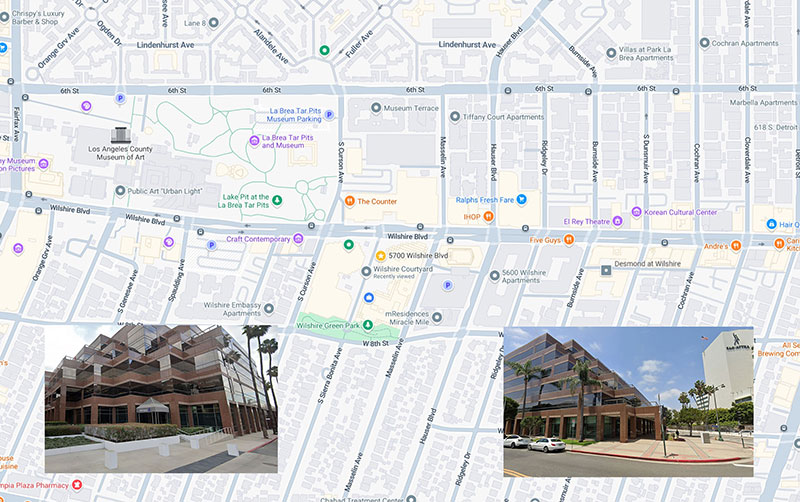
June brings a diverse lineup of programs exploring Japanese art, culture, craftsmanship, and film. Highlights include an online lecture by Seikichi Izumi X, the sole heir to a 370-year-old urushi lacquer brushmaking tradition; the final weeks of Manifesting Icons: The Materials and Making of Buddhist Visual Culture in Asia; and Sanzen Daisen Sekai, a thought-provoking solo exhibition by Heng Yi. Later in the month, two new exhibitions, Kinetic Stillness: Sculptural Ceramics Exhibition and Tea Ceremony with Pacific Plastics open with a special reception featuring artist talks, workshops, and tea ceremony experiences. Audiences can also enjoy Japanese cinema from home with new additions to JFF Theater, including *Sumo Do, Sumo Don’t* and *YUDO*, two acclaimed films that offer unique perspectives on Japanese traditions and community life. One quick note: We've noticed that Google Maps has been incorrectly marking our location. Please make sure your search directs you to Mid-Wilshire, between Masselin and S Curson Ave. The entrance is located on Courtyard Place. You can find a map and street view of our building below for easy reference.
|
|
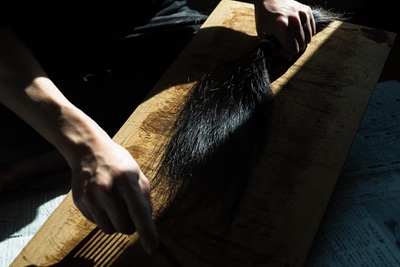 |
ONLINE LECTURE This online lecture centers on the craft of urushi brush making, presented by Seikichi Izumi X, a lacquer brush artisan from a lineage dating back to the 17th century. For over 370 years since Seki Izumi I, he has been the sole inheritor of traditional Edo techniques, using human hair as the primary material, passed down exclusively through oral tradition from generation to generation, and continues to preserve them to this day. Lacquer brushes are used to apply urushi to lacquerware such as Wajima-nuri, as well as to swords and armor. They also play an essential role in the restoration of ancient Japanese treasures, including temples and shrines, national treasures, and important cultural properties, where lacquer is widely used. The talk will explore where urushi is used, the essential role of brushes designed specifically for its application, and the importance of tools in traditional craftsmanship. |
|
|
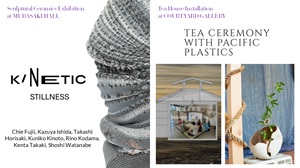
DUAL OPENING RECEPTION DUAL OPENING RECEPTION: Two exhibitions will open concurrently and remain on view through September 19. The opening reception will feature a special workshop by participating artist Kenta Takaki, visiting from Japan, as well as tea ceremony offerings. The evening will also bring together participating artists and collaborators in celebration of ceramic practice, material experimentation, and exchange. Kinetic Stillness: Sculptural Ceramics Exhibition This exhibition brings together seven Japanese and Japanese American artists who approach ceramics not as vessels for utility or tradition, but as sculptural sites of flux. Tea Ceremony with Pacific Plastics (TCwPP) This exhibition showcases ocean-inspired tea utensils created by the collective in collaboration with various artists, an upcycled tea room, and a small zen garden made entirely from shopping bags and salvaged ocean plastics. |
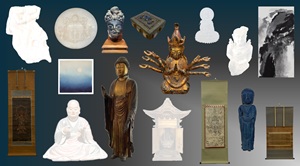 |
ART EXHIBITION Buddhist sutras explain that donating to projects like paintings and sculptures was a way for Buddhist devotees to accumulate good karma for themselves and their loved ones. Through this, they could be reassured of a good rebirth in a Buddhist paradise. This exhibition emphasizes the production of Buddhist visual culture across Asia and situates Japan’s Buddhist art within that context. By displaying Buddhist sculptures and paintings alongside the materials and tools that would have been used to create them, we show that Buddhist art is the result of skilled labor and quality materials. |
|
|
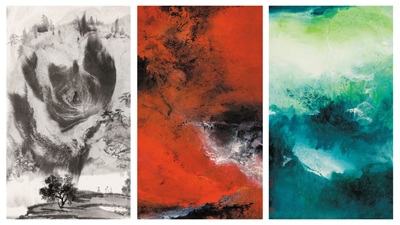
ART EXHIBITION Japan Foundation Los Angeles and a poco art present Sanzen Daisen Sekai (三千大千世界), a two-chapter solo exhibition by Heng Yi. Chapter I, Realm of Infinite Radiance, opens outward; Chapter II, Realm of Yūgen, turns inward. Together, they move along the axis of form and emptiness (色 / 空). Sanzen Daisen Sekai, the Great Trichiliocosm, or “Three Thousand Great Thousand Worlds,” describes a Buddhist cosmology of vast, interpenetrating worlds. Here, it unfolds as a field in tension between what appears and what resists resolution. To see all forms as not-form is not to reject the image, but to refuse its completion. The fully resolved image risks attachment (著相); the incomplete one keeps perception in motion. |
|
|
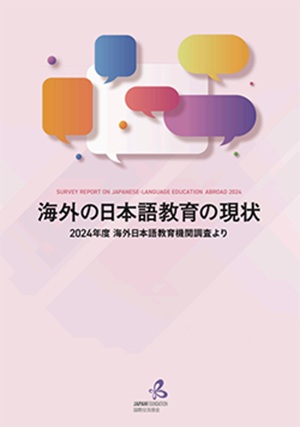
ANNOUNCEMENT The long-awaited results of the 2024 Survey on Japanese-Language Education Abroad in English have now been published on the Japan Foundation website. The report provides a comprehensive overview of the current global landscape of Japanese-language education, including recent enrollment trends, key developments, and related insights. |
|
|
ON DEMAND Starting June 3, JFF Theater will stream two films that showcase different aspects of Japanese culture: *Sumo Do, Sumo Don’t* (1992), a comedy directed by Masayuki Suo about a carefree college student who reluctantly joins a struggling university sumo club in order to graduate, and *YUDO* (2023), a family drama directed by Masayuki Suzuki that follows an architect who returns home after his father’s death and gradually rediscovers the value of Japan’s traditional bathhouse culture while helping run his family’s public bath. Both films will be available to stream from June 3, 2026, at 11:00 AM (JST) through September 2, 2026, at 11:00 AM (JST). |
|
|
NEW TEACHING MATERIALS
New materials for Japanese Heritage Language (JHL) education were made public on our Kyozai site. Please find the introduction and URL below: "In this section, we present six practical examples designed to support the learning of children who are connected to Japan around the world. The ages of the learners vary, as do the ways in which goals are set, the duration of the activities, and the topics addressed. The learning activities and materials introduced here may be used as they are or adapted to suit your specific context. They may also serve as a source of inspiration for developing new activities."
|
 |
|
|
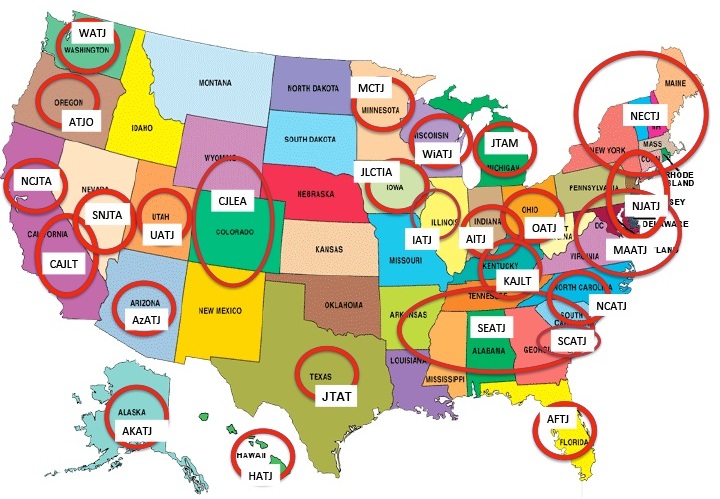
Joining a Teacher Association There are many teacher associations around the country that can provide networks, support, information, professional development opportunities, conferences, events, leadership opportunities, and many other benefits for their members. If you are part of a teacher association already, great! If you are not a member of a teacher association yet, it is highly recommended to join one. The American Association of Teachers of Japanese (AATJ) is a good place to start if you are looking for an association to join. You can find their website here: https://aatj.org/ AATJ also has many affiliate associations that might include a local teacher association near you. This map has some associations you can find: This page also has ways to connect with these associations: https://aatj.org/affiliates/ While this map does not have every Japanese teacher association in the US on it (only AATJ affiliates), it does provide a great snapshot of the nation at large. If you don’t see a teacher association near you on this list or if you want to know how to connect with an association, feel free to reach out to: jflaeducation@jpf.go.jp |
|
 |
|
|
Keisho Nihongo Support Programs Applications are now open for the 2026–27 Japanese Heritage Language (JHL) Support Program. Two types of support are available:
In previous years, the application period ran from September through January of the following year. Beginning in 2026, however, the application window will open in April. 2026–27 Application Period: April 1, 2026 – January 31, 2027 This revised timeline is intended to accommodate a broader range of JHL events and to provide schools with greater flexibility in integrating donated materials into their curricula. JHL schools and programs interested in applying for event support or book donations are encouraged to visit the following pages for more information: (Japanese): https://www.jflalc.org/jle-keishonihongo-programsj If you have any questions, please send inquiries to (jared_mcclellan@jpf.go.jp). |
|
 |
General Invitation to Join JF USA Digital Library We recently renewed and added many new books in coordination with our New York and Toronto offices for our patrons in the US and Canada. There have also been an uptick in the number of applicants as well, which shows that this is a very popular service. We have also updated the application survey and the confirmation emails are still going out once a week on Wednesdays by 6:00PM pacific time. If you register and do not receive a welcome email from us within a Wednesday of registering, please contact us so we can help you out. |
 |
|
|
2026-2027 Japanese Language Grants Now Available! Grant for Nationwide/Statewide/Region-wide Events for Learners Japanese Language Learners Event Grant Grant for Nationwide/Statewide/Region-wide Projects for Teachers Japanese-Language Education Project Grant Grants for Individual Japanese Language Programs Japanese Teaching Material Purchase Grant Advocacy Support Letter If your Japanese language program is in danger of being cut due to COVID-19, we will send a support letter to stakeholders (Superintendent, Principal, Dean, etc.). Click Here to contact us and select Anything Related to Japanese Education. |
|
Japanese Language Education Update 149
This month, we are pleased to launch the 2026 Training Program for Japanese Language Teachers in the United States. Developed in response to the need to strengthen US–Japan relations through grassroots exchange and to build professional networks among educators across the United States, the program invites two groups of Japanese language teachers for an intensive three-week training experience. The first group will arrive in Los Angeles this week for a brief orientation before traveling to the Japan Foundation Japanese-Language Institute in Urawa, where they will take part in language training, school visits, and a study tour to Kanazawa. The second group will depart in the fourth week of June. We hope all participants will have a meaningful and memorable experience in Japan, and we look forward to learning from the insights they will bring back to their classrooms and communities. In other program news, Magdalena Mastrandrea, from the University of Maryland, recently completed our Japanese-Language Program for Specialists at our institute in Kansai. You can read her reflections and experiences here. Researchers, graduate students, librarians, and museum curators interested in future opportunities should check out our website in late September for information on the next application cycle. We would also like to welcome Magara Maeda sensei, who will be joining our Japanese language team starting this month as Senior Japanese Language Specialist. She was previously at the University of Wisconsin - River Falls, and will be managing efforts to support Japanese language education in the United States. We also want to highlight the release of the 2024 Survey on Japanese-Language Education Abroad by the Japan Foundation. This comprehensive report offers an in-depth overview of global trends in Japanese language education, including enrollment patterns and emerging developments, and provides valuable insights for educators, administrators, and policymakers worldwide. |
|

5700 Wilshire blvd, Suite 100
Los Angeles, CA 90036
jflainfo'at'jpf.go.jp
323.761.7510